
Organic search is not disappearing so much as changing its delivery system, and manufacturers built around website clicks are discovering that visibility alone no longer guarantees revenue.
The old bargain: For most of the internet era, organic search operated on a relatively clear exchange. A manufacturer published useful product pages, technical documentation, comparison content, or application guidance. Google ranked those pages, buyers clicked through, and the resulting visits created measurable opportunities for quote requests, distributor inquiries, sample orders, and sales. Search rankings were imperfect, but they were legible. A company could connect impressions to clicks, clicks to sessions, and sessions to conversions. This model made search engine optimization a central growth channel for industrial brands that lacked the advertising budgets or consumer familiarity of larger competitors. In manufacturing, where buying cycles are long and product specifications matter, being present when an engineer or procurement manager searched for a solution could influence a relationship worth thousands or millions of dollars.

Human visits may fade. Revenue does not have to. Before any buyer sees your brand, The machines at ChatGPT, Perplexity, Claude, Gemini, and all leading AI engines has read it: the engines and agents that study everything about you and decide who gets recommended. Win Audience Zero. Win the revenue.
The first decoupling: That bargain began to weaken before generative AI became visible to most users. Google filled results pages with featured snippets, knowledge panels, local packs, product modules, video, images, shopping results, and “People Also Ask” boxes. Searchers increasingly received enough information without visiting the underlying source. The gap between ranking and traffic widened: a page could remain highly visible while receiving fewer clicks. This was the beginning of the decoupling, the separation of search visibility from website visits. For manufacturers, the effect was easy to miss because rankings and impressions often looked healthy in reporting dashboards. Yet informational content, especially articles answering broad technical questions, was losing its ability to move buyers onto a company-owned property where forms, specifications, contact details, and conversion paths were available.
The gap widens: AI Overviews accelerated that separation by placing synthesized answers above traditional results. Searchers can now ask complex questions about materials, tolerances, applications, suppliers, or product differences and receive an answer assembled from multiple sources. Semrush reported that AI Overviews appeared across 38 percent of monitored manufacturing and industrial search volume in January 2026, rising to 57 percent by July. At the same time, AI search tools accounted for only 0.48 percent of sessions to manufacturing websites, while direct and organic search together represented nearly 80 percent of sessions. Those figures describe a transitional market. AI referrals remain small, but AI-generated answers increasingly occupy the moment when a buyer forms an opinion, often before a website visit occurs. Organic traffic can therefore decline even while search remains influential.
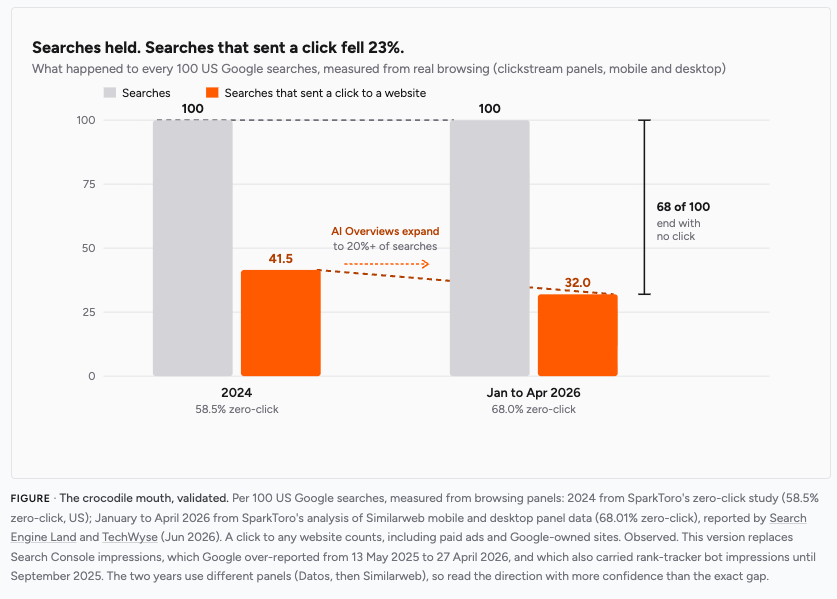
Visibility without visitation: The commercial consequence is a new kind of measurement problem. A manufacturer may continue to be cited, summarized, or used as a source while receiving fewer sessions from the query that created the exposure. Conversely, a company can lose both clicks and representation if an AI system selects competitors, distributors, forums, or generic sources instead. Search Engine Land reported that 73 percent of B2B websites experienced significant traffic losses between 2024 and 2025, with an average year-over-year decline of 34 percent. The same analysis noted that informational sectors were especially vulnerable. For industrial brands, this means a fall in organic sessions is not merely a marketing inconvenience. It can reduce qualified demand, weaken distributor flow, obscure early research activity, and make revenue attribution look worse precisely when buyers still use search to identify credible suppliers.
The second reemergence: Organic search is now reappearing in a different form. The decisive question is no longer only whether a company ranks on a results page, but whether its products, facts, and expertise are represented inside an answer generated by Google, ChatGPT, Gemini, Perplexity, or another system. This is not a simple replacement of SEO with “AI optimization.” AI systems draw from a wider evidence environment that includes manufacturer websites, trade publications, review platforms, distributor catalogs, standards organizations, technical communities, and structured product data. A brand may rank traditionally yet disappear from an AI answer, while another brand with weaker conventional rankings may be included because its specifications are clearer, more consistently repeated, or better supported across trusted sources. The reemergence is therefore broader than search ranking. It is the return of discoverability as a distributed reputation and data problem.
Brands dropping out: The most serious risk belongs to companies that are absent from AI answers while competitors remain present. Research shared with Marketing Dive found that more than 40 percent of brand citations in traditional organic results did not appear in AI Overviews for the same query, while 28 percent of brands cited by AI did not appear in conventional organic results. Separate 2026 research found that only 30 percent of brands remained visible from one AI answer to the next, and just 20 percent appeared across five consecutive runs. These figures indicate substantial volatility, not a stable new ranking page. A manufacturer can be influential in one query and invisible in a closely related prompt. The dropout is commercially significant because buyers may never know the missing company existed, especially when AI answers compress a large supplier landscape into a short recommendation set.
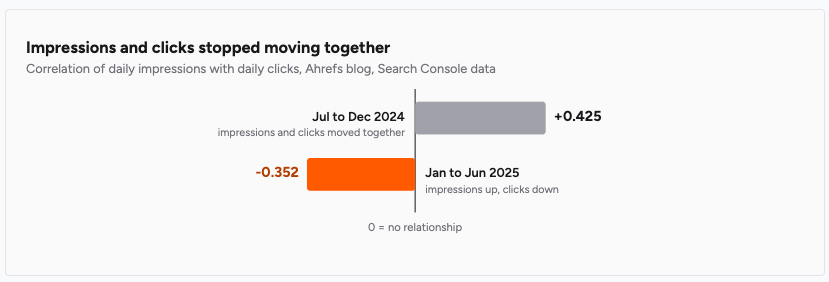
Manufacturing exposure: Manufacturers face distinctive pressure because their value is often encoded in details that generic web pages handle poorly. Buyers need exact grades, dimensions, certifications, lead times, compatible equipment, environmental limits, testing methods, and application constraints. If those facts are scattered across PDFs, outdated catalogs, distributor pages, and inconsistent product names, an AI system may not confidently connect them to the correct company. It may provide a vague category answer, cite a competitor with cleaner data, or omit the manufacturer entirely. The revenue effect can begin well before a form submission disappears. Engineers may shortlist fewer suppliers, procurement teams may ask distributors about brands they saw in an AI answer, and sales teams may enter conversations after competitors have already defined the category. The lost asset is not only traffic. It is early preference formation.
The new operating model: Manufacturers need to treat organic search, AI visibility, and revenue as connected but separate systems. Traditional analytics should continue tracking rankings, impressions, sessions, engagement, and conversions, but those metrics must be supplemented with brand mentions, product citations, answer inclusion, source accuracy, recommendation frequency, and visibility across repeated prompts. Product records should use consistent names, technical attributes, applications, certifications, and availability signals. High-value expertise should be published in accessible HTML as well as downloadable documents, supported by independent references and credible third-party coverage. Marketing, product, engineering, sales, and distributor teams must share responsibility for the facts that shape machine-generated answers. The objective is not to chase every AI platform. It is to make the company easy to identify, accurately describe, and confidently recommend wherever buyers now conduct research.
What comes next: The transition will not produce a clean moment when organic search ends and AI search begins. Instead, the two systems will coexist while the relationship between visibility, clicks, and revenue continues to loosen. AI search currently sends a small share of manufacturing traffic, but its influence is expanding faster than referral numbers suggest because it shapes discovery before a buyer reaches a website. Traditional organic results will remain important for validation, branded research, technical verification, and high-intent actions. The manufacturers best positioned for this environment will measure both the visit and the invisible influence that precedes it. Companies that rely solely on rankings may conclude that search is failing. Companies that monitor where their products are named, how their specifications are interpreted, and whether competitors occupy the answer will see the deeper change: search did not go missing. The click moved, and the decision moved with it.
Sources: Semrush, Marketing Dive, Search Engine Land, HubSpot, Frac.tl, AirOps, LBOX.com

Complete industry reports. Real time data on any product. Connect with 50M manufacturers. Connect to every product, company, and industry expert in seconds, all linked in one place. No ads. No SPAM. Direct connections.