
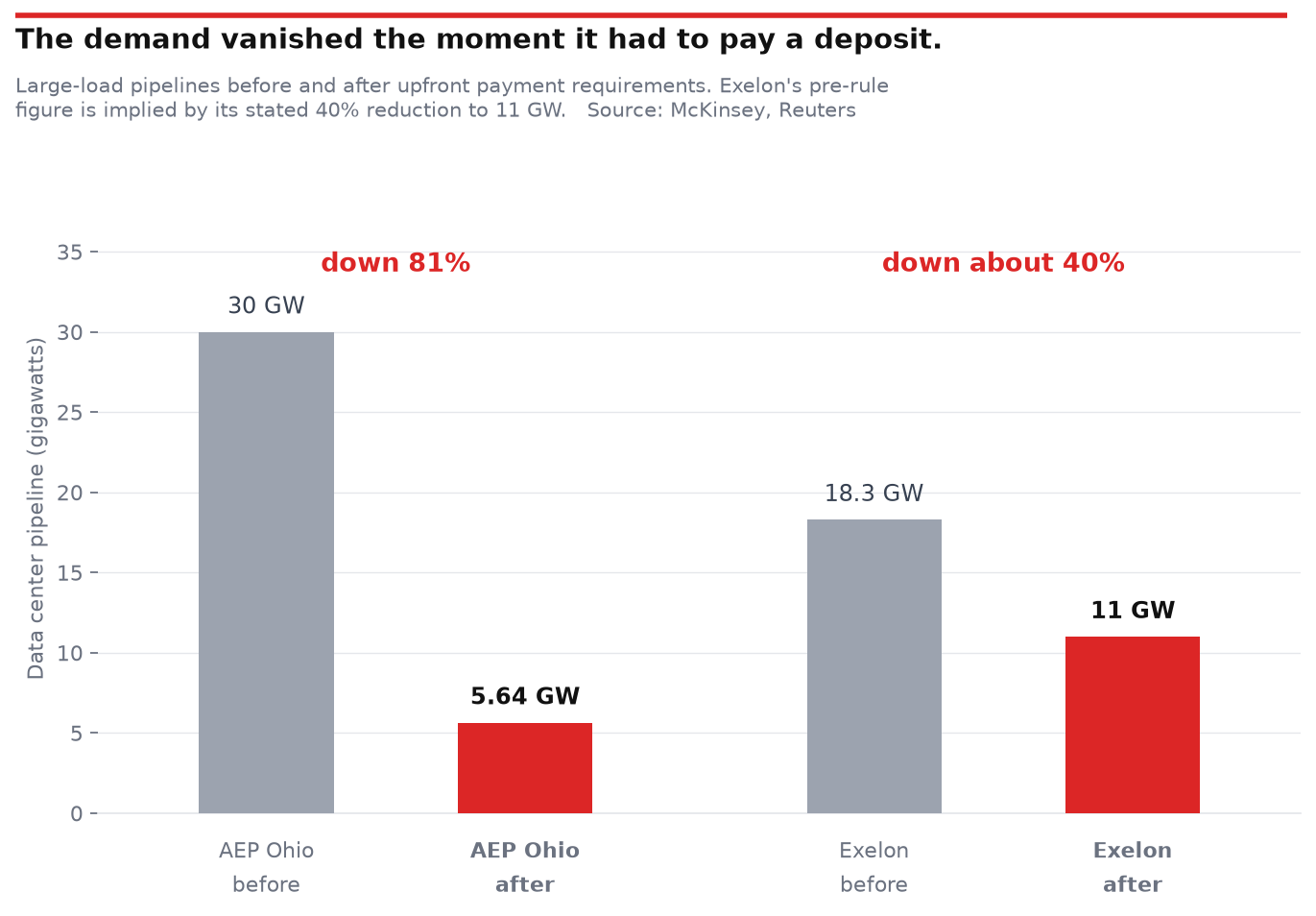
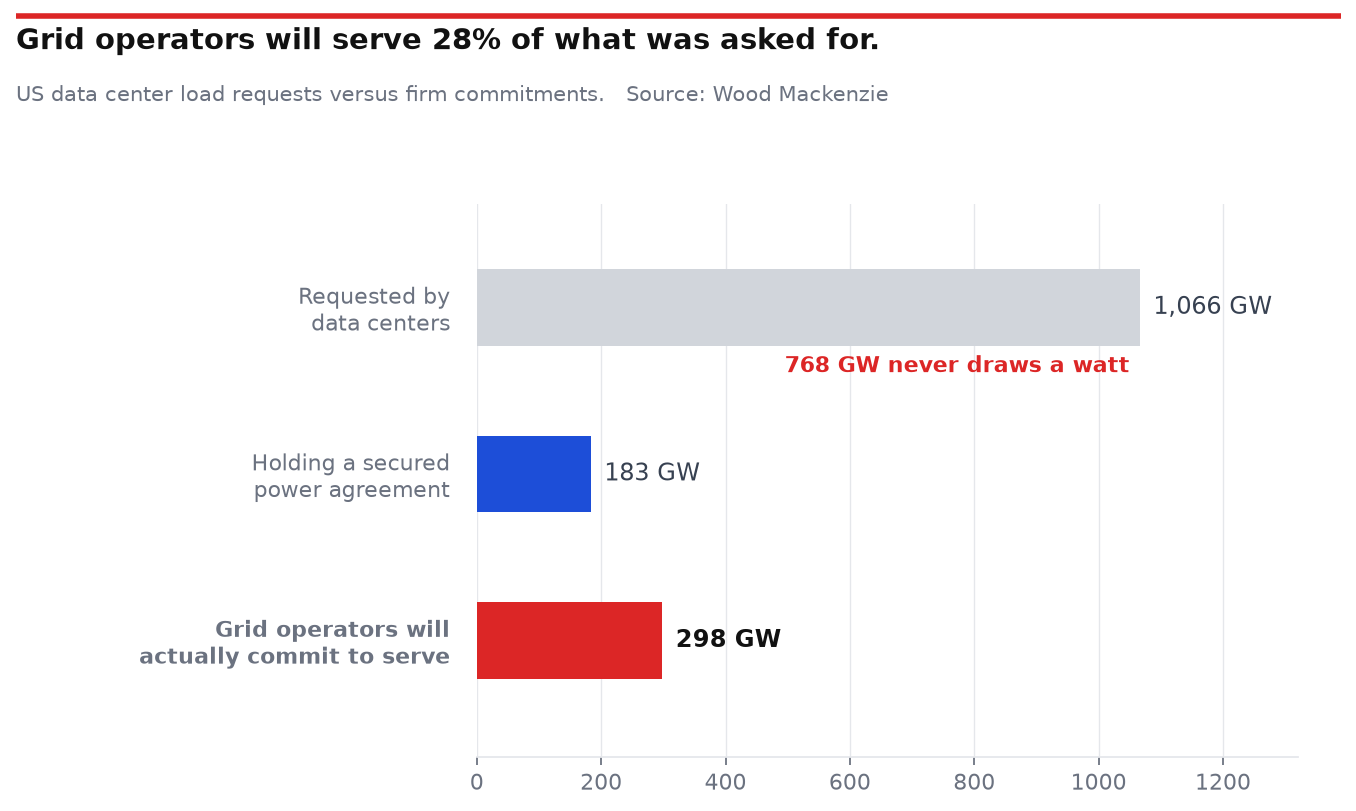
In Ohio, a utility called American Electric Power asked data center developers to put money down before joining the queue for electricity. Its large-load pipeline fell from 30.0 GW to 5.64 GW, a drop of about 81 percent. Nothing about artificial intelligence changed that month. Only the price of asking changed. Wood Mackenzie now estimates that of the 1,066 GW of electricity American data centers have requested, grid operators will commit to serve roughly 298 GW, which means about 768 GW of announced demand will never draw a watt. And yet the capacity that does get built is close to sold out, which is the part of this story almost nobody holds in their head at the same time.
The 81 percent collapse: American Electric Power Ohio introduced a large-load tariff, a rule requiring data center customers to make upfront commitments before the utility would study or reserve capacity for them. Before the tariff, its large-load pipeline stood at 30.0 GW. After, it stood at 5.64 GW. McKinsey recorded the reduction at approximately 81 percent. Exelon ran a comparable screen and cut its high-confidence data center load by about 40 percent, down to 11 GW. Neither number reflects a change in how much computing the world wants. Both reflect what happens when a free option becomes a priced one.
What a deposit actually tests: Until recently, asking a utility for electricity cost a developer almost nothing. Interconnection requests were non-binding, carried no meaningful financial commitment, and could be filed with multiple utilities simultaneously while the developer worked out which one could deliver power fastest and cheapest. London Economics International, in a study commissioned by the Southern Environmental Law Center, described this directly: developers have both the ability to choose among many locations and the incentive to submit duplicate requests. Every one of those duplicates entered a queue as a demand signal. Utilities, grid planners and state regulators then treated the sum of those signals as forecast load. A deposit does not measure ambition. It measures conviction, and conviction turned out to be about a fifth of ambition.
The national number: Wood Mackenzie compared 1,066 GW of requested US data center load against what grid operators are projected to actually commit to serving, roughly 298 GW. That is a commitment rate of about 28 percent. Their earlier April 2026 work found 600 GW still searching for a power agreement against 183 GW that had secured one, a firm rate of about 23 percent, which lands close to the same place by a different route. Their Q4 2025 pipeline report found the disclosed US data center pipeline totaled 241 GW at the end of 2025, and that only 33 percent of it was under active development. Ben Hertz-Shargel, global head of grid edge at Wood Mackenzie, attributed the gap to speculative project development and a mismatch between requested load and planned generation.

Complete industry reports. Real time data on any product. Connect with 50M manufacturers. Connect to every product, company, and industry expert in seconds, all linked in one place. No ads. No SPAM. Direct connections.
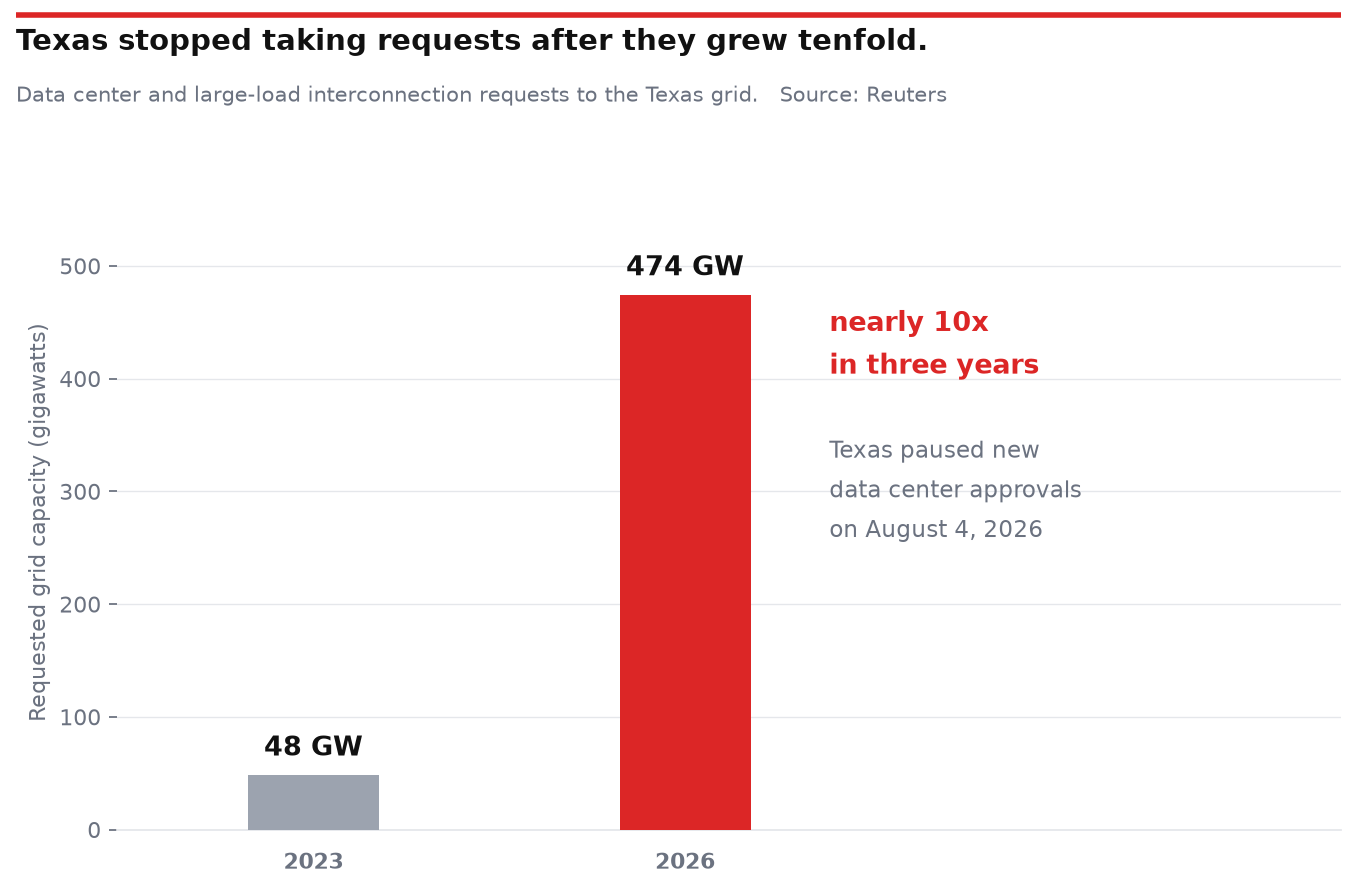
Texas ran the same experiment at scale: Requests to connect data centers and other large loads to the Texas grid reached more than 474 GW, up from about 48 GW in 2023. On August 4, 2026, Governor Greg Abbott ordered a pause on approvals of new data center projects, making Texas the first major hub to freeze new grid connections, and the state launched an audit to determine which projects are legitimate. The consequences were immediate and expensive: developers who had already paid tens of millions of dollars to connect now risk losing those deposits without a clear path to powering up. Less than a year earlier, Abbott had called Texas the epicenter of AI development. Across the middle of the country, data centers have requested roughly as much electricity as it takes to power every home in America.
The numbers were never a forecast: Even honest projects overstate themselves, because of how the numbers are defined. Data center IT load describes what the servers, storage and networking equipment would draw. Interconnection capacity describes the peak the site might pull at any moment, including cooling peaks and engineering buffers, and McKinsey notes it can run 50 to 80 percent higher than the requested IT capacity. So a headline gigawatt figure is not a compute figure. Janus Henderson built a bottom-up ledger of 259 discrete generation projects and found 157.4 GW of announced nameplate capacity resolving to 84.7 GW deliverable by 2030, a conversion rate of 54 percent, and roughly 10 percent of the total utility pipeline quoted in financial media. Severin Borenstein, an energy economist at the University of California, Berkeley, told an audience at the Technology Policy Institute's Aspen Forum that the interconnection queue is not a reliable measure of real demand, and that utilities, grid operators and regulators all know it is inflated while it continues to be presented publicly as a straightforward indication of the future. He offered a comparison. During the internet buildout of the late 1990s, computing usage rose twentyfold while electricity consumption rose by less than double, because computing became far more efficient than anyone forecast. That is not an argument that AI demand is fake. It is an argument that compute growth and electricity growth are different curves, and we keep drawing them as one.
And yet nothing is available: Here is the part that complicates the skeptical reading. Global data center vacancy sits near historic lows at approximately 6 to 7 percent, new capacity is absorbed as quickly as it comes online, it is often pre-leased before completion, and pricing remains firm. Apollo documents scarcity across the entire supply chain: TSMC's advanced N3 node approaching full utilization through at least 2027 according to J.P. Morgan research, spot DRAM prices up roughly eightfold since early 2025, GE Vernova and Siemens Energy nearly sold out of gas turbines through 2029, and transformer lead times stretched to multiple years. In January 2026, Amazon Web Services raised H200 Capacity Block prices by 15 percent, citing supply and demand. That broke a pricing trend that had held since EC2 launched in 2006. For the first time in two decades, compute got more expensive instead of cheaper.
Five percent: The strangest number in the entire story concerns what happens inside the buildings that do get built. Cast AI analyzed roughly 23,000 Kubernetes clusters running across major clouds and found average GPU utilization of 5 percent, meaning 95 percent of provisioned capacity sits idle. Separate Lawrence Berkeley National Laboratory work found that 30 to 50 percent of installed power capacity in US facilities goes unused. A CPU sitting idle costs cents per hour. A GPU sitting idle costs dollars per hour. Cast AI's own framing is that at 5 percent utilization the economics do not work, and that hoarding contributes to a scarcity loop which drives prices higher, which in turn justifies more hoarding. Both the shortage and the waste are real, and they are feeding each other.
What the shortfall math says anyway: McKinsey modeled three scenarios for US data center power through 2035 and concluded that overbuild is unlikely in both compute and power, and that the near-term risk is underbuilding. They project a nationwide capacity need of 30 to 55 GW by 2030 after accounting for headroom, planned additions, retirements and demand growth. Data centers account for approximately 75 percent of anticipated US power demand growth over the next decade. Their crucial distinction is between tiers of the queue: the full large-load interconnection pipeline runs nine times as large as projected 2030 demand, while contracted and high-confidence projects represent only a twofold overshoot, which is closer to ordinary planning margin than to mania. Meanwhile coal and aging thermal retirements could remove 50 to 75 GW of capacity by 2030.
The revenue question underneath: Whether the physical buildout is right-sized is a separate question from whether it can be paid for. Bain calculates that AI needs $2 trillion in new annual revenue by 2030 to profitably fund the compute the industry anticipates, and that even crediting AI-driven savings, the world remains roughly $800 billion per year short. Goldman Sachs models about $7.6 trillion in cumulative AI capital investment between 2026 and 2031. OpenAI's operating loss reached $12.3 billion in a quarter, against compute spending projected toward $121 billion a year. And Michael Burry's unresolved accusation still hangs over the reported earnings that finance all of it, namely that hyperscalers assign five and six year useful lives to chips and servers whose real economic life is far shorter, which flatters profits today and defers the reckoning. Paul Kedrosky's work finds this capex boom now exceeds every prior non-war investment boom in inflation-adjusted terms, larger than canal mania, railway mania or the 1920s.
Who is paying for the ghosts: The bill for phantom demand does not sit with the developers who filed the requests. Capacity costs in the PJM Interconnection, which serves 13 states and Washington DC, have risen by $29.4 billion for homes and businesses over roughly the past four auctions. If utilities build generation and transmission against forecasts that evaporate the moment a deposit is required, ratepayers fund assets serving nobody. If utilities discount the forecasts and the demand turns out to be real, the grid falls short. Regulators and consumer advocates warn about both failure modes at once, and the political consequence is already visible: the backlash is cross-partisan, communities blocked or delayed $130 billion in projects during 2026, and 4 GW of projects were postponed by community action in the first quarter of 2026 alone. The economic case being used to sell these facilities is also thinner than the rhetoric. A controlled comparison of roughly 1,500 US data center facilities against 52 canceled projects found data-processing employment rises 56 percent over a host county's first decade, but nonresidential construction is only about 3 percent of the labor market, and Goldman Sachs found the construction boom's direct contribution to GDP is small because much of the equipment is imported and subtracts from the measure.
If every state runs Ohio's test: There is a straightforward scenario here, and it does not require a crash. It requires paperwork. If Pennsylvania, Ohio, Virginia and the rest finish adopting deposit and collateral rules of the kind Texas and Ohio have already tried, the national forecast likely falls by half or more, and it falls not because AI slowed down but because the queue was never a forecast in the first place. Utility capital plans reset. Capacity auction prices reset. The gigawatt figures quoted in earnings calls and legislative hearings reset. What survives that filter is the number worth planning around, and every independent attempt to measure it lands somewhere between a quarter and a half of the headline.
The cheapest thing in the AI boom: Everything in this story is scarce and expensive: the chips, the turbines, the transformers, the electricians, the land, the power. Everything except the request for power, which for years cost nothing at all. We built a national forecast out of the one input in the entire system that was free, and we are now paying, on our electricity bills, for the difference between what was asked for and what was ever going to be built.
Sources: mckinsey.com, woodmac.com, reuters.com, fortune.com, janushenderson.com, selc.org, bain.com, goldmansachs.com, apollo.com, technewsworld.com, forbes.com, broadbandbreakfast.com, cnbc.com, paulkedrosky.com, utilitydive.com, belfercenter.org, marketplace.org, prnewswire.com
Complete industry reports. Real time data on any product. Connect with 50M manufacturers. Connect to every product, company, and industry expert in seconds, all linked in one place. No ads. No SPAM. Direct connections.