Technosylva and Pano AI are merging predictive modeling with live detection, and the partnership signals where a fast-growing category is headed.
Utilities and fire agencies have spent the last several fire seasons trying to reconcile two very different kinds of truth at the same time.
One is predictive. It lives in models that ingest weather, fuels, terrain, and historical behavior to estimate where a fire is most likely to start, how it might spread, and what it could threaten next. The other is immediate. It shows up as a faint column of smoke on a ridge camera, a first 911 call, a heat signature, or a wind shift that turns a manageable flank into a sprint.
Neither view is wrong. The problem is that they tend to live in separate systems, updated on different cadences, interpreted by different teams, and reconciled in the most expensive place possible: the middle of an active incident.
That's the operational gap Technosylva and Pano AI say they're closing with a partnership announced February 3, 2026. And it arrives at a moment when the market for what's now being called "Real-Time Wildfire Intelligence" is maturing quickly.
A category finding its infrastructure moment
The wildfire detection and defense market is no longer niche. The global forest wildfire detection system market was estimated at roughly $3 billion in 2025 and is projected to grow at a compound annual growth rate above 10%, reaching more than $7 billion by 2034, according to Market Research Future. Other analysts tracking the broader wildfire protection market, which bundles detection, suppression, and mitigation technologies together, peg it at $4.5 billion in 2024, headed toward $9.2 billion by 2033. North America holds the largest regional share, driven largely by regulatory mandates and utility spending in California.
The underlying science is familiar by now. Warming and drying have stretched fire seasons and left fuels drier across much of North America. NASA has noted that fire seasons in some regions now run more than a month longer than they did a few decades ago. The January 2025 Los Angeles fires, which caused estimated property losses between $76 billion and $131 billion according to UCLA researchers, drove the point home for a national audience in a way that statistics alone never quite manage.
On the utility side, the spending numbers speak for themselves. California's three largest investor-owned utilities (PG&E, Southern California Edison, and SDG&E) received state approval to collect $27 billion from ratepayers for wildfire prevention. PG&E alone spent $11.7 billion on wildfire costs between 2020 and 2022, and devoted 24% of its total revenue to wildfire-related costs in 2024. California's legislature expanded the state Wildfire Fund through Senate Bill 254 in 2025, creating an $18 billion continuation account to backstop future utility wildfire liabilities. This isn't seasonal budgeting anymore. It's multi-year capital infrastructure.
Those pressures have created a market that rewards tools doing two things well: reducing uncertainty before ignitions happen (risk forecasting, operational planning, pre-positioning, PSPS decision support) and reducing time to confirmation and response once one does (detection, verification, intelligence sharing, unified incident context). For years, many organizations tried to cover both by buying best-in-class point solutions and stitching workflows together with operating procedures, screen sharing, and manual handoffs. That approach works until it doesn't.
Why "predictive plus visual confirmation" changes the decision loop
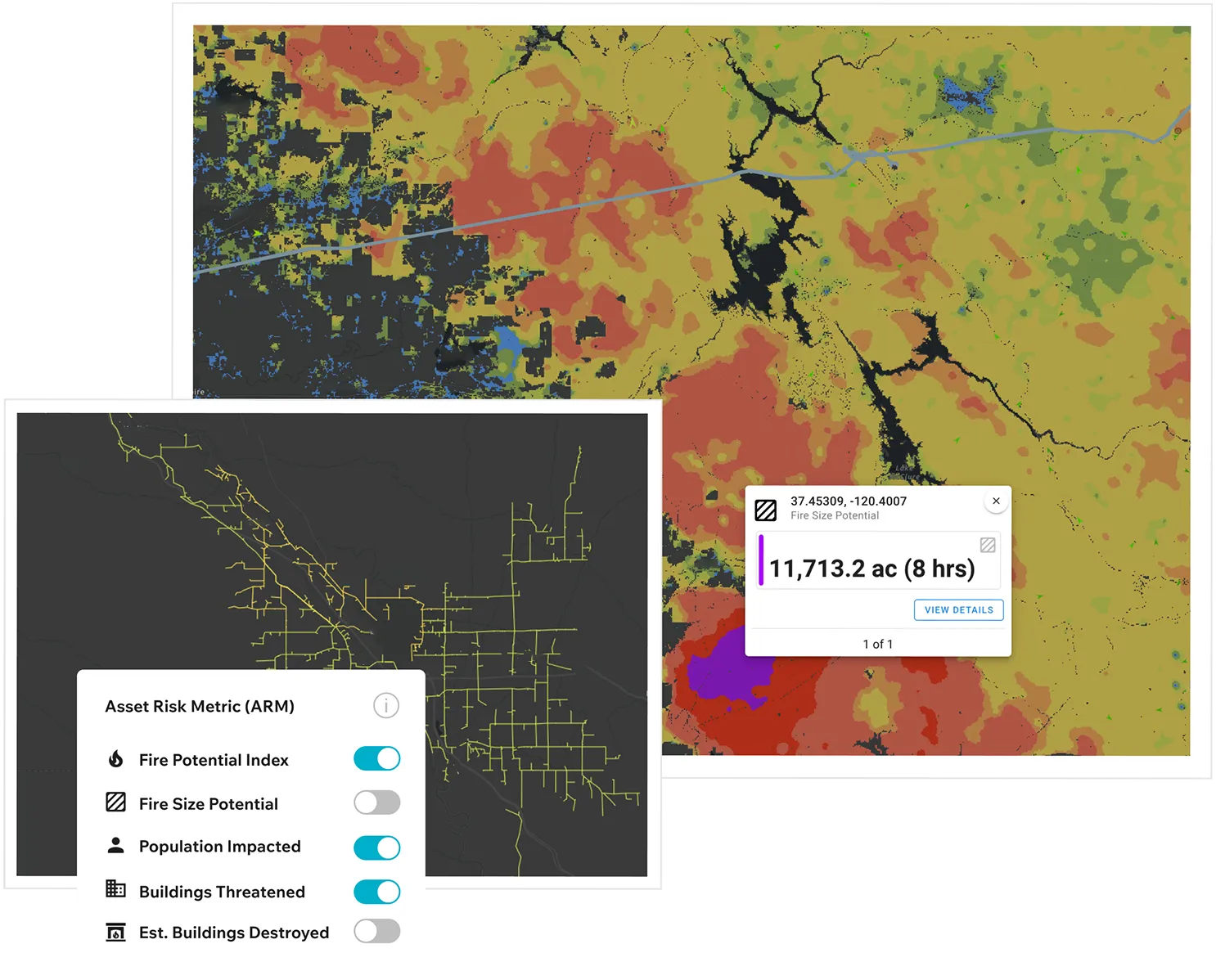
Technosylva's strength is the forward-looking view: predictive wildfire risk, fire behavior, and spread modeling. Their modeling stack is rooted in the same family of fire behavior science that underpins much of operational simulation, including widely used approaches derived from the Rothermel surface fire spread model, first developed in the early 1970s and still foundational in many of the systems agencies rely on today.
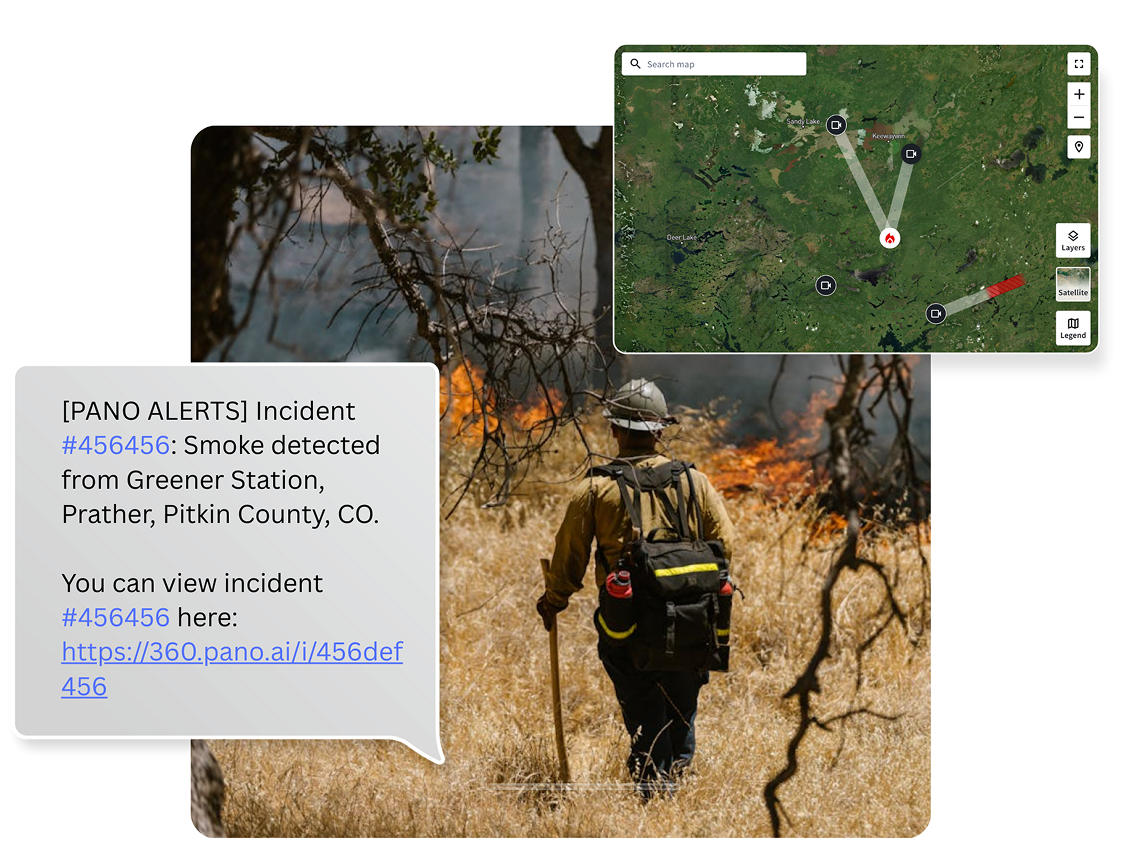
Pano AI's strength is the present tense: AI-assisted detection using fixed cameras, visual confirmation, and incident intelligence designed to shorten the window between ignition and coordinated action.
Think about a typical early incident window. A detection platform flags smoke and offers a likely location. The question for an operator isn't just "is it real?" It's "is it the kind of real that becomes catastrophic under current conditions?" That's a modeling question. Wind alignment, fuel moisture, topographic channeling, spotting potential, expected rate of spread. All of it matters in the first minutes, not two hours later when an analyst has time to run a separate simulation.
Now flip the scenario. A predictive model shows elevated risk in a corridor and suggests likely spread pathways if a fire starts. The question becomes: "What's actually happening on the ground right now?" That's a real-time intelligence question, and it's hard to answer with confidence unless you have visual confirmation and shared incident context.
The partnership integrates both directions. Pano's live camera views and incident intelligence show up inside Technosylva's risk and modeling environment. Technosylva's simulations and projections show up inside Pano's incident management platform. Done well, that means less swiveling between dashboards and fewer translation steps between planning teams and response teams.
What utilities will actually judge this on
It's tempting to frame this as "AI meets AI." In practice, utilities and agencies are going to evaluate it on a narrower set of outcomes.
Faster confirmation with fewer false escalations. Real-time detection reduces time to awareness, but any system that triggers too often creates fatigue. Connecting an alert to contextual risk helps operators triage with intention instead of just reacting.
Earlier coordination with fire agencies. A shared operating picture matters most when multiple organizations need to get aligned fast: utility operations centers, dispatch, field crews, responding agencies. If both sides are looking at the same evidence and the same forward projection, coordination starts from shared facts rather than persuasion.
Better resource pre-positioning. Predictive modeling is most valuable when it changes where assets sit before things go wrong. Real-time confirmation helps validate whether the anticipated risk is actually materializing and where to shift next.
Clearer communication under uncertainty. Wildfires are a probabilistic problem. Models aren't guarantees. Camera views aren't omniscience. A unified interface can make uncertainty more explicit: here's what we know, here's what's likely, here's what's changing. That kind of explicitness matters when decisions carry regulatory and legal weight.
A market consolidating around platform behavior
The wildfire technology landscape has been fragmented for a while now. Satellites, cameras, lightning data, weather feeds, fuels mapping, operations platforms, simulation tools, and a growing analytics layer built for utilities, insurers, and government agencies. The trend is toward platforms that behave more like mission control: fewer disconnected tools, more interoperable intelligence, tighter loops between detection and decision.
The spending environment supports that direction. PG&E is planning to bury 10,000 miles of power lines. California's Wildfire Fund is now backstopped to $18 billion. At that scale, the tools that document decisions, reduce response time, and improve defensibility aren't optional. They're part of the operating baseline.
Technosylva and Pano say they'll validate deployments with select mutual customers before broader availability. The practical questions will come down to specifics. How seamlessly can users move from a camera-confirmed ignition to an immediately relevant model run? How clearly does the interface communicate confidence, uncertainty, and assumptions? Can the combined workflow support utility and agency needs at the same time without forcing one side into the other's mental model? And does it actually reduce time to action, or does it just consolidate screens?
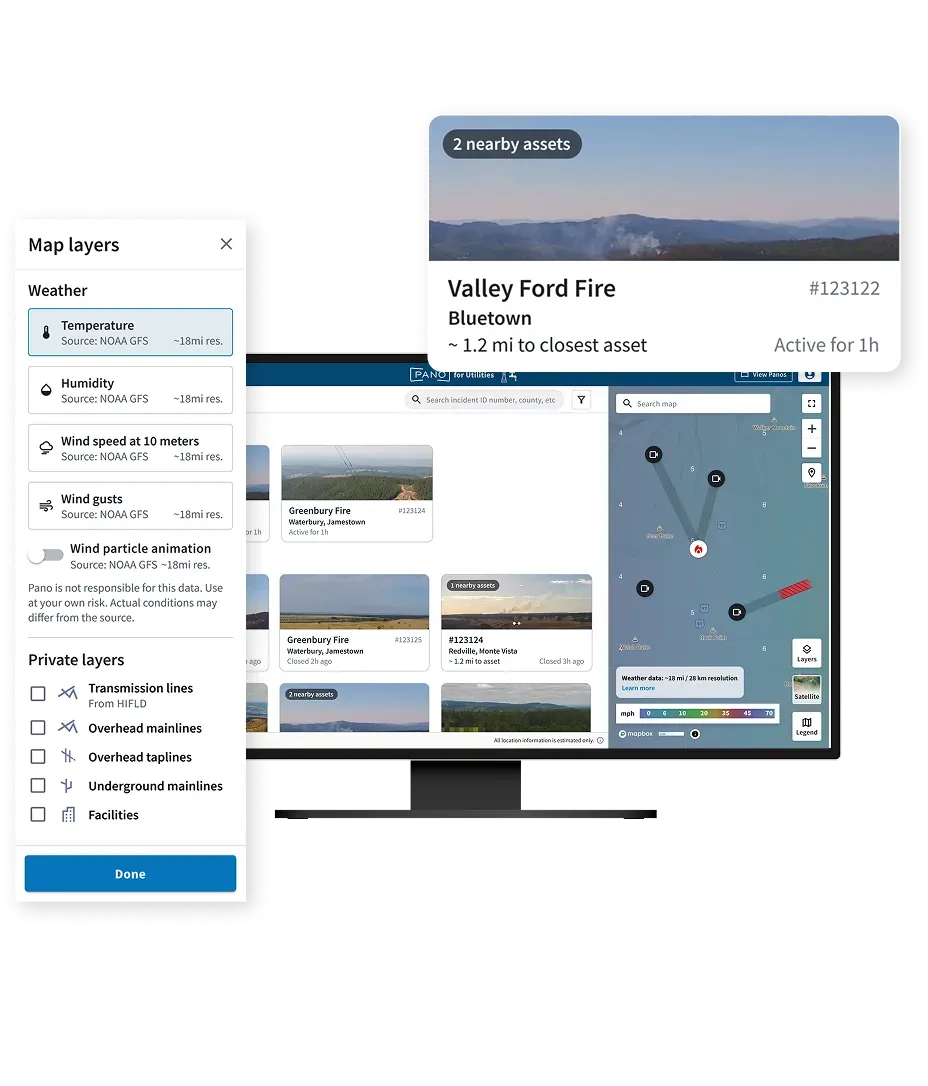
If the answers hold up, this partnership sits right at the center of where the category is going: wildfire intelligence that isn't just predictive or just real-time, but bidirectional and continuous. The season is longer. The decisions are faster. The most useful intelligence is the kind that shows you what's happening now and what happens next, at the same time.
Thanks for reading. 100% free, unbiased coverage and briefs on urgent developments in EVs, AI, robotics, energy, markets, tariffs, defense, and off-grid innovation. If you would like to win in today's volatile markets, please share it with a friend. If this newsletter was forwarded to you, sign up here