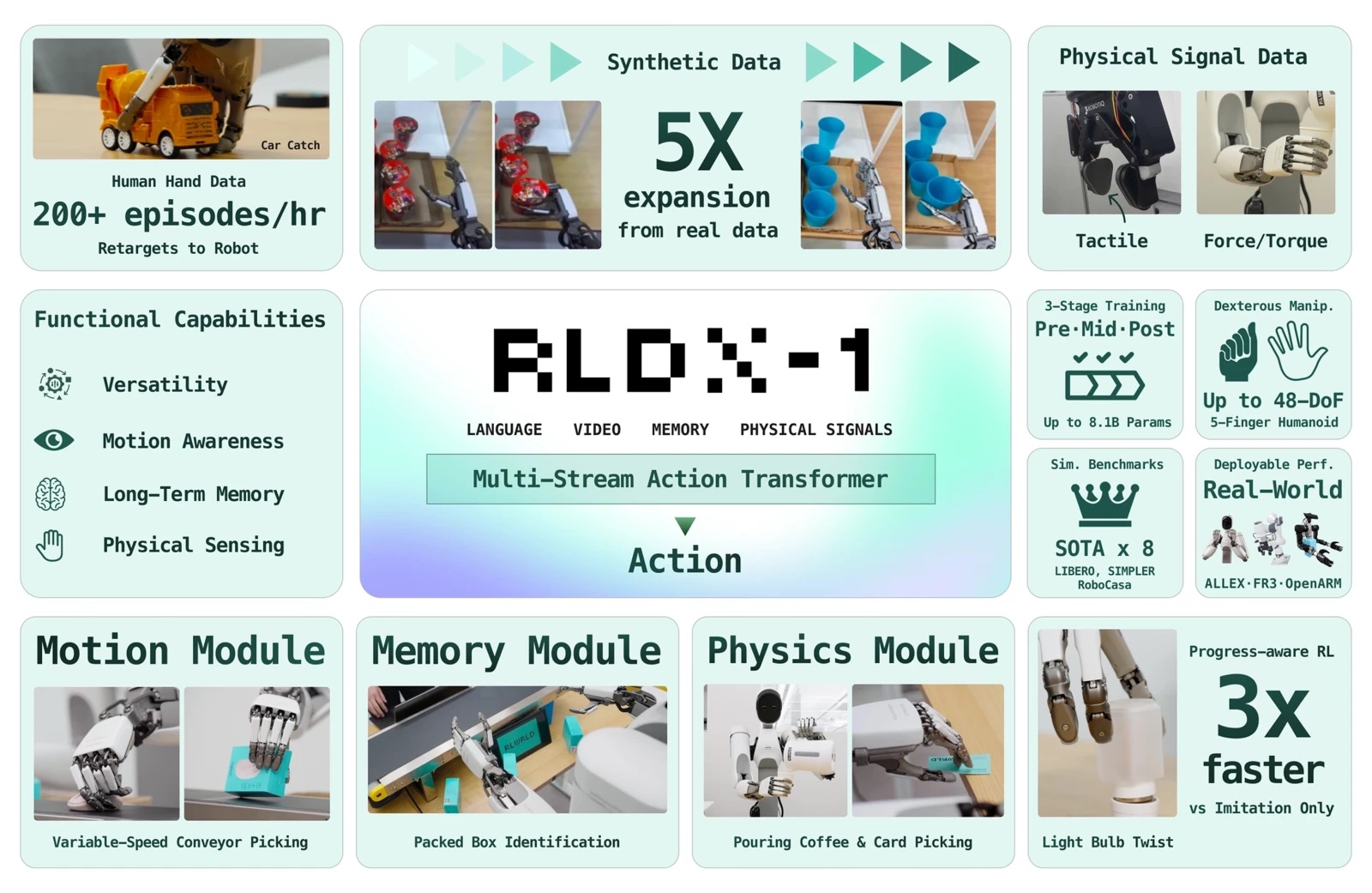
- RLWRLD has launched RLDX-1, a foundation model specifically designed to enhance the dexterity of robotic hands, addressing critical limitations in existing models.
- The model integrates a comprehensive robotics lifecycle approach, combining advanced data collection, architecture, training, and deployment strategies to achieve superior performance in real-world applications.
- RLDX-1's architecture, built on a Multi-Stream Action Transformer, allows for effective processing of diverse modalities, enabling robots to perform complex tasks with improved precision and adaptability.
The introduction of RLDX-1 by RLWRLD marks a significant advancement in the field of robotics, particularly in the realm of dexterous manipulation. As industries increasingly demand robots capable of performing intricate tasks, the limitations of existing models—such as inadequate context memorization and force sensing—have become glaringly apparent. RLDX-1 aims to fill these gaps by providing a robust foundation model that not only recognizes actions but also maintains relevant state information over time, grounding decisions in meaningful physical signals. This capability is essential for real-world applications where precision and adaptability are paramount.
RLDX-1 is designed to encompass the entire robotics lifecycle, integrating a scalable data-collection pipeline, versatile architecture, and optimized deployment strategies. This holistic approach allows the model to achieve state-of-the-art performance across both simulated environments and physical industrial applications. RLWRLD emphasizes that every component of RLDX-1 was developed in response to specific failure modes encountered in real tasks, resulting in a model that can see, feel, remember, and adapt. This adaptability is crucial for deployment across various robotic embodiments, including single-arm, dual-arm, and humanoid configurations equipped with high-degree-of-freedom hands.
Central to RLDX-1's capabilities is its identification of five regimes of dexterity, which address common failure modes in current robotic systems. These regimes—grasp diversity, spatial precision, temporal precision, contact precision, and context awareness—highlight the multifaceted challenges that robotic hands face in real-world scenarios. By leveraging a combination of synthetic and human data, RLWRLD has developed a benchmark, DexBench, to systematically evaluate and enhance these dexterity regimes. This structured approach not only informs the model's training but also ensures that it can handle the complexities of tasks such as pouring coffee or manipulating moving objects with finesse.
The architecture of RLDX-1, based on a Multi-Stream Action Transformer, is a key innovation that allows for the simultaneous processing of diverse modalities, such as torque, video, and memory. This design prevents the common issue seen in traditional models where one modality dominates the processing capacity, leading to suboptimal performance. By allowing each modality to maintain its own processing stream while still enabling interaction through joint self-attention, RLDX-1 can effectively integrate sensory inputs and cognitive processing. This results in a more nuanced understanding of the environment and improved execution of complex tasks, setting a new standard for dexterous robotic manipulation.