- Researchers have developed a modular robot that enhances resilience by sharing resources among its units, effectively reducing the likelihood of failure.
- This innovative approach, termed hyper-redundancy, allows individual modules to compensate for each other's deficiencies, thus maintaining overall functionality.
- The findings suggest significant implications for the design of adaptive robotic systems, particularly in complex environments and potential applications in robotic swarms.
The urgency of advancing robotic resilience is underscored by the increasing complexity of tasks that robots are expected to perform in dynamic environments. Traditional designs often face a paradox: as robots become more modular and capable of diverse functions, the risk of failure escalates due to the increased number of components. The breakthrough achieved by Jamie Paik and her team at the Reconfigurable Robotics Laboratory (RRL) at EPFL presents a compelling solution to this challenge, demonstrating that resource-sharing among modules can actually enhance reliability rather than diminish it.
The research team’s findings, published in Science Robotics, reveal that by implementing a system of local resource sharing, they were able to create a modular origami robot that successfully navigated complex terrains even when one of its modules was entirely non-functional. This approach leverages the concept of hyper-redundancy, where critical resources such as power, communication, and sensing capabilities are distributed across all modules. This contrasts sharply with previous designs that relied on isolated backup systems, which often failed to restore full functionality when a module became incapacitated.
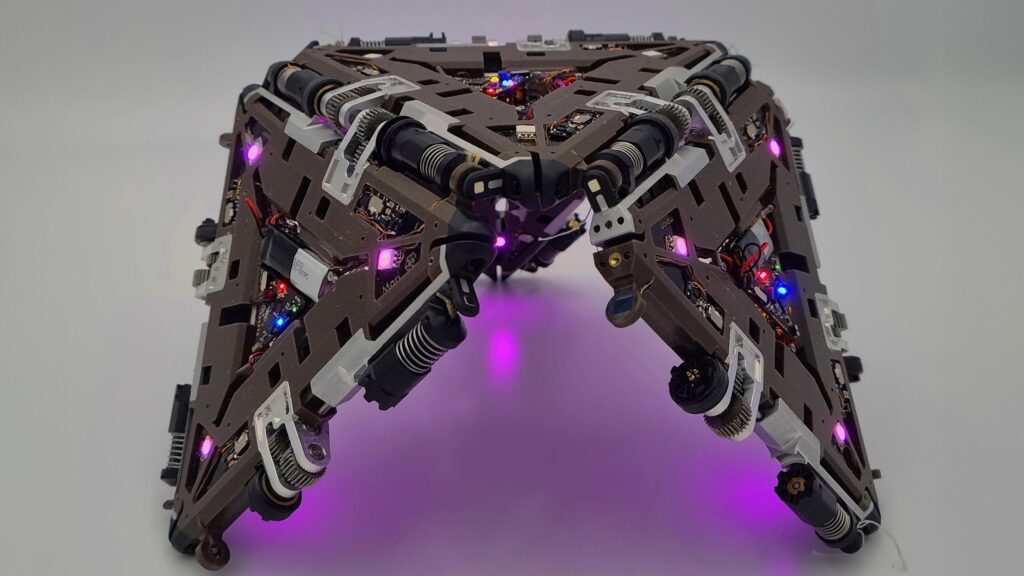
Inspired by natural systems where collective behavior mitigates individual failures, the RRL team’s methodology draws parallels to how organisms operate. For instance, birds in a flock share sensory information, and trees communicate threats to their neighbors. By mimicking these biological strategies, the researchers have effectively turned a potential vulnerability of modular robots into a strength. Their experiments with the Mori3 robot, which consists of four interconnected triangular modules, demonstrated that even when one module was deprived of resources, the remaining modules could compensate, allowing the robot to perform complex movements.
This innovative framework not only resolves the reliability-adaptability conflict inherent in robotic design but also opens avenues for future research. The potential applications of this resource-sharing paradigm extend to more complex robotic systems and swarms, where the ability to dock and share resources could enhance operational efficiency and resilience. As the field of robotics continues to evolve, the implications of this research could lead to the development of highly adaptive robots capable of functioning reliably in unpredictable environments.