- Ouster's release of the Stereolabs ZED X Nano marks a significant advancement in robotic vision systems, emphasizing the need for high-quality, low-latency image data in Physical AI applications.
- The ZED X Nano's compact design and advanced features address critical limitations of legacy cameras, enhancing robotic manipulation and learning capabilities.
- With its robust integration with NVIDIA and ROS platforms, the ZED X Nano positions itself as a vital tool for teams engaged in imitation and reinforcement learning.
The introduction of the Stereolabs ZED X Nano by Ouster is a pivotal moment for the robotics industry, particularly as the demand for sophisticated vision systems continues to escalate. The ZED X Nano is not just another camera; it represents a leap forward in how robotic systems can perceive and interact with their environments. As robotics teams increasingly rely on imitation learning and reinforcement learning for complex manipulation tasks, the limitations of traditional cameras—characterized by low resolution and high latency—become more pronounced. Ouster's latest offering directly addresses these challenges, making it a timely and necessary innovation in the field.
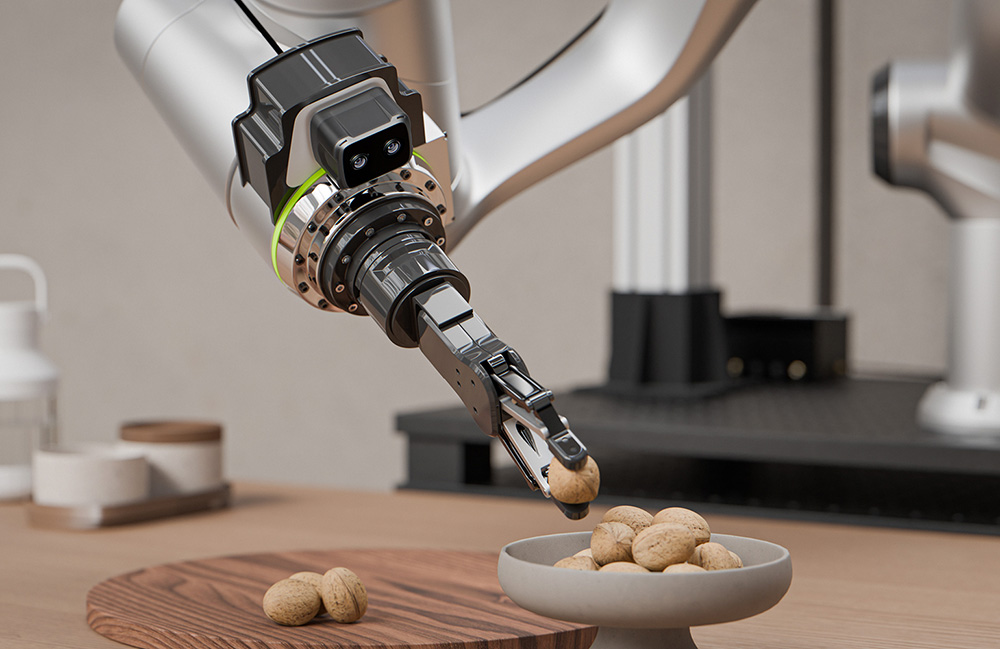
The ZED X Nano is engineered to be 40% smaller in height compared to existing solutions, allowing for seamless integration onto robotic wrists and end-of-arm tooling. This compact design is crucial for applications where space and weight are at a premium. By leveraging a high-resolution 1920×1200 global shutter sensor, the camera can capture RGB and depth images at an impressive 120 frames per second. This capability is essential for generating the high-quality training data needed to enhance the performance of robotic systems in real-world scenarios.
Central to the ZED X Nano's functionality is its ultra-low-latency capture pipeline, which facilitates a zero-copy path from sensor to GPU. This design allows for simultaneous processing of frames through NVIDIA hardware encoders and AI inference pipelines, significantly boosting throughput for data collection teams. The camera's depth sensing, powered by Stereolabs’ Neural Depth Engine, offers sub-millimeter accuracy, which is critical for tasks that require precise grasp pose estimation and placement. This level of accuracy is a game-changer for applications in assembly and manipulation, where even minor errors can lead to failure.
Durability is another key feature of the ZED X Nano, designed to withstand the rigors of robotic applications. The camera utilizes a ruggedized GMSL2 connection, replacing the fragile USB-C with an industrial-grade link capable of transmitting video over longer distances while resisting electromagnetic interference. This robust design ensures that the camera can endure the repeated motion and stress associated with robotic arms, making it a reliable choice for demanding environments.
Moreover, the ZED X Nano's compatibility with NVIDIA Isaac Sim and ROS platforms enhances its appeal to teams focused on developing advanced robotic systems. By enabling high-fidelity demonstrations and seamless transitions from simulation to real-world deployment, the camera supports a comprehensive sensor and software stack that is essential for modern robotics research and development. As teams continue to push the boundaries of what is possible in robotic manipulation and learning, the ZED X Nano stands out as a critical tool that will likely shape the future of Physical AI.