- Operation XENOFISCAL represents a sophisticated spear phishing campaign targeting Afghanistan's Ministry of Finance, utilizing a combination of social engineering and advanced malware techniques.
- The deployment of XenoRAT, an open-source Remote Access Trojan, underscores the threat actor's intent for long-term surveillance and control over sensitive government operations.
- By embedding their operations within Afghanistan's own internet infrastructure, the attackers have enhanced their stealth and evasion capabilities, complicating detection efforts by security teams.
The emergence of Operation XENOFISCAL is a critical development in the landscape of cyber threats, particularly given its targeting of the Afghan Ministry of Finance. This operation not only highlights the ongoing risks faced by governmental institutions in conflict-affected regions but also illustrates the evolving tactics employed by threat actors. The SideCopy APT group, linked to Pakistan, has demonstrated a clear understanding of its targets, employing a spear phishing strategy that leverages cultural and linguistic nuances to increase the likelihood of success.
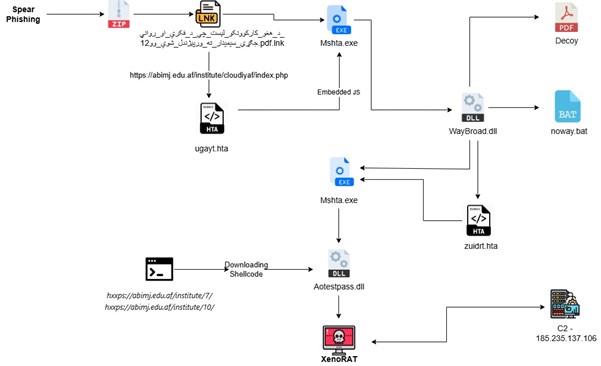
The campaign begins with a meticulously crafted spear phishing email that delivers a ZIP archive containing a malicious LNK file. This file, disguised with a Pashto filename related to a fictitious seminar, is designed to entice provincial finance officials. The choice of Pashto is particularly telling; it reflects an intimate knowledge of the operational context within Afghanistan's government, suggesting that the attackers have conducted thorough reconnaissance. Once the LNK file is executed, it triggers a chain of events that leads to the deployment of XenoRAT, a potent tool for remote access and surveillance.
The infection chain is characterized by a series of sophisticated techniques aimed at evading detection. The initial LNK file utilizes mshta.exe to fetch a remote HTA payload, which then executes obfuscated JavaScript to establish persistence and download the XenoRAT payload. This multi-layered approach not only minimizes the risk of detection by traditional security measures but also allows the malware to operate entirely in memory, further complicating forensic analysis. The use of registry-based persistence mechanisms ensures that the malware can survive system reboots, maintaining a foothold within the compromised environment.
Infrastructure analysis reveals that the attackers have cleverly embedded their operations within Afghanistan's own internet framework, utilizing domains associated with Afghan educational institutions. This tactic not only helps to mask malicious activity within legitimate traffic but also indicates a strategic choice to exploit local resources for operational advantage. The presence of over 200 legitimate Afghan government and education domains co-hosted on the same infrastructure suggests a calculated effort to blend in and evade detection, making it increasingly difficult for cybersecurity teams to identify and mitigate the threat.
In conclusion, Operation XENOFISCAL exemplifies the growing sophistication of cyber threats targeting governmental institutions, particularly in regions with complex geopolitical dynamics. The combination of targeted social engineering, advanced malware techniques, and strategic infrastructure use underscores the need for heightened vigilance and proactive defense measures within vulnerable sectors. As the threat landscape continues to evolve, understanding and adapting to these tactics will be essential for safeguarding sensitive information and maintaining operational integrity in the face of persistent cyber threats.