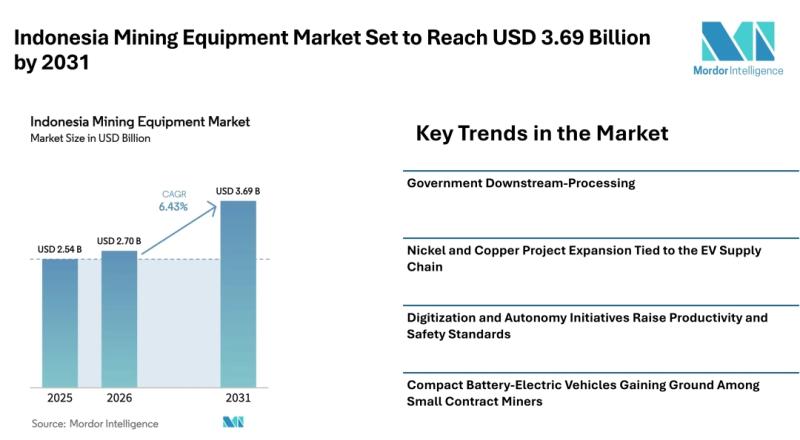
- The Indonesia mining equipment market is projected to grow significantly, reaching USD 3.69 billion by 2031, primarily fueled by the expansion of the electric vehicle (EV) supply chain.
- Key growth drivers include increasing demand for minerals essential for EV batteries, such as nickel and cobalt, alongside government initiatives to boost mining operations.
- The market's growth reflects broader trends in sustainable mining practices and technological advancements in equipment efficiency.
The urgency of the Indonesia mining equipment market's projected growth underscores a pivotal moment for the region's economy and its role in the global supply chain, particularly as the demand for electric vehicles accelerates. As the world shifts towards greener technologies, Indonesia stands to benefit significantly from its rich mineral resources, especially those critical for EV batteries. The anticipated market size of USD 3.69 billion by 2031 signals not just a financial opportunity but also a strategic positioning for Indonesia in the global mining landscape.
The report from Mordor Intelligence highlights that the current market valuation of USD 2 billion is set to expand due to several factors. A primary driver is the increasing global demand for minerals like nickel and cobalt, which are vital for the production of EV batteries. As automakers ramp up their production of electric vehicles, the pressure on mining operations to supply these essential materials intensifies. This demand is further supported by government initiatives aimed at enhancing mining operations and attracting foreign investment, which are crucial for scaling up production capabilities.
Moreover, the report indicates that technological advancements in mining equipment are also playing a significant role in this growth. Innovations aimed at improving efficiency and sustainability are becoming increasingly important as the industry grapples with environmental concerns. The shift towards more sustainable mining practices not only aligns with global trends but also enhances the competitiveness of Indonesian mining operations on the world stage. As companies adopt more advanced technologies, they are likely to see improved productivity and reduced operational costs, further driving market expansion.
The implications of this growth extend beyond mere economic metrics; they reflect a broader transformation in how mining is perceived and executed in Indonesia. The focus on the EV supply chain aligns with global sustainability goals, positioning Indonesia as a key player in the transition to a low-carbon economy. As the mining equipment market evolves, stakeholders must navigate the challenges of balancing resource extraction with environmental stewardship, ensuring that growth does not come at the expense of ecological integrity.
In conclusion, the Indonesia mining equipment market is on the cusp of significant transformation, driven by the dual forces of EV supply chain demands and technological advancements. This growth trajectory not only promises substantial economic benefits but also necessitates a careful approach to sustainable practices. As Indonesia capitalizes on its mineral wealth, the global mining community will be watching closely to see how it navigates this critical juncture.