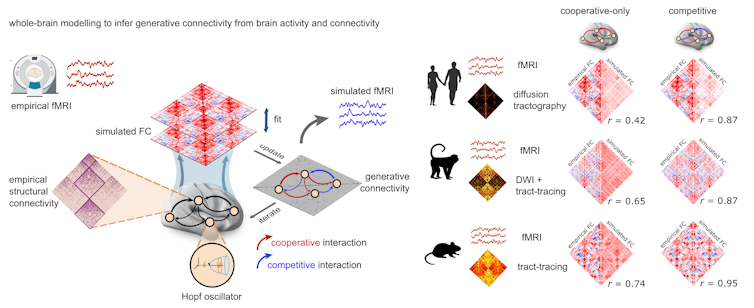
- Digital twins of the human brain must incorporate competitive interactions between brain regions to accurately reflect individual neural dynamics.
- Current models that overlook these competitive dynamics risk producing generic simulations that fail to personalize treatment predictions.
- Advancements in brain modeling could bridge the gap between animal studies and human clinical applications, enhancing treatment efficacy for neuropsychiatric disorders.
The urgency of refining digital twins of the human brain is underscored by their potential role in personalized medicine, particularly as tools for simulating treatment responses before real-world application. As neuroscience continues to evolve, the ability to accurately replicate the unique neural architecture of individuals becomes paramount. Current models, which often resemble distant relatives rather than true twins, fail to capture the intricate wiring that defines each person's cognitive landscape. This inadequacy not only limits the effectiveness of these models but also raises concerns about the reliability of their predictions in clinical settings.
Recent research highlights a critical oversight in existing brain simulations: the neglect of competitive interactions among brain regions. While many models have historically emphasized cooperation, the reality of cognitive function involves a dynamic interplay where different systems vie for limited resources. This competition is essential for the brain's ability to prioritize tasks and manage cognitive load effectively. The study reveals that models incorporating these competitive dynamics yield results that are not only more accurate but also more reflective of individual brain fingerprints, thus enhancing their relevance for personalized treatment approaches.
The implications of these findings extend beyond theoretical modeling; they could revolutionize translational neuroscience. The high failure rate of neuropsychiatric treatments in human trials, often attributed to species differences in animal models, could be mitigated by employing digital twins that integrate human brain imaging data. Such a framework would facilitate a more seamless transition from basic research to clinical application, allowing for tailored interventions that consider the unique neural configurations of patients. This shift could lead to more effective treatment strategies, particularly for conditions like epilepsy or tumors, where precise stimulation protocols are crucial.
Moreover, the principles derived from this research may inform the development of future artificial intelligence systems. By understanding the competitive nature of brain interactions, AI models could be designed to mimic human cognitive processes more faithfully. This convergence of neuroscience and AI not only promises advancements in technology but also offers insights into the fundamental workings of intelligence itself. As researchers continue to refine these digital twins, the potential for breakthroughs in both medical and technological domains becomes increasingly tangible.