- Offline programming (OLP) significantly accelerates the deployment of robotic machining applications, reducing setup times from days to minutes.
- OLP tools enable manufacturers to simulate and validate complex machining paths without production downtime, enhancing operational efficiency.
- The integration of computer-aided manufacturing (CAM) capabilities within OLP software is crucial for optimizing robotic machining processes and ensuring precision.
The urgency surrounding the adoption of offline programming (OLP) in robotic machining cannot be overstated, particularly as manufacturers face increasing demands for flexibility and speed in production. As industries shift towards high-mix, low-volume manufacturing, the ability to rapidly deploy automation solutions becomes a competitive advantage. OLP addresses the significant bottleneck of manual programming, which can extend deployment timelines and increase the risk of errors, thereby enabling companies to respond more swiftly to market needs.
Robotic machining has gained traction due to its cost-effectiveness and adaptability compared to traditional CNC machines. While CNC systems excel in precision for high-stakes sectors like aerospace, they often represent an over-engineered solution for applications requiring less stringent accuracy. In contrast, robots can efficiently handle a variety of materials, including wood and aluminum, at a lower cost without compromising quality. However, the complexity of robotic programming, particularly in defining intricate paths, has historically hindered widespread adoption.
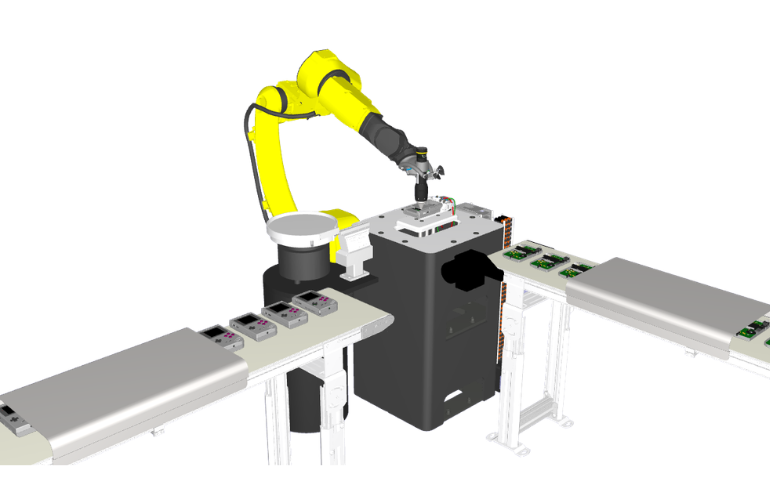
The introduction of OLP software fundamentally transforms this landscape by automating the programming process. Instead of relying on manual coding, which is prone to human error and inefficiencies, OLP allows users to work within a virtual environment that accurately reflects the physical workspace. This capability enables the automatic generation of machining paths from CAD models, drastically reducing the time required for setup and allowing for the exploration of complex geometries that would be impractical to program manually.
Moreover, the integration of CAM functionalities within OLP tools is essential for effective robotic machining. This integration facilitates automated toolpath generation and advanced multi-axis strategies, which are crucial for achieving the precision required in machining applications. By simulating the machining process, engineers can identify and rectify potential issues—such as singularities and collisions—before actual deployment, thereby minimizing the risk of costly errors and production downtime. As manufacturers increasingly recognize the value of OLP, the focus is shifting from whether robots can perform machining tasks to how quickly they can be instructed to do so, marking a significant evolution in manufacturing practices.