- Fraunhofer IPA is addressing the critical issue of low absolute accuracy in industrial robots, which can significantly impair performance in various applications.
- Inaccurate robots lead to inefficiencies, particularly in processes requiring precise positioning, such as welding and offline programming.
- Improving absolute accuracy not only enhances operational efficiency but also offers economic advantages and boosts competitiveness for companies utilizing robotic systems.
The challenge of achieving high absolute accuracy in robotic systems is becoming increasingly urgent as industries demand more precision in their automated processes. While robots are known for their repeatability, the gap in absolute accuracy—typically ranging from 0.5 to 1.5 mm—poses significant limitations for applications that require exact positioning. This discrepancy can lead to quality issues, particularly in tasks like welding, where even minor deviations can result in defective products or rework, ultimately affecting productivity and operational costs.
Fraunhofer IPA is actively investigating the root causes of these inaccuracies, which can stem from hardware deficiencies, software calibration issues, or external environmental factors. For instance, the design of the robot, including the quality of encoders and gears, plays a crucial role in its performance. Moreover, poor calibration and inadequate controller performance can exacerbate the problem. The increasing integration of cognitive functions in robotic systems, which rely on sensor data for real-time adjustments, further complicates the accuracy landscape. If sensor data is flawed or if the interaction between components is suboptimal, the robot's performance can suffer significantly.
The implications of low absolute accuracy extend beyond immediate operational challenges; they can disrupt the entire production chain. For example, offline programming (OLP) becomes inefficient when the programmed tasks cannot be executed accurately, necessitating time-consuming corrections that lead to machine downtime. This inefficiency not only hampers productivity but also increases the likelihood of additional work steps, such as re-teaching, which further detracts from overall efficiency. As industries increasingly adopt automation, the demand for robots that can achieve absolute accuracy comparable to their repeatability is becoming a necessity rather than a luxury.
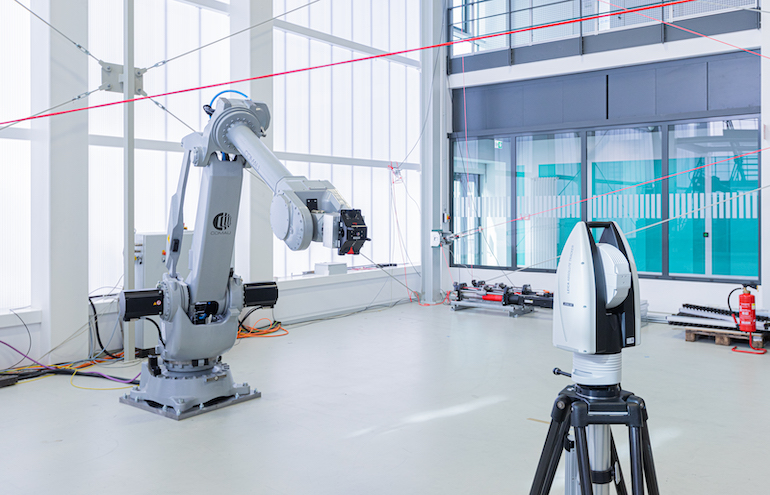
To address these challenges, Fraunhofer IPA employs a comprehensive analysis approach that begins with a detailed assessment of the current robotic systems using advanced sensor technology. By establishing a solid database of performance metrics, the team can identify specific areas of concern and develop targeted solutions. Their newly developed closed-loop benchmark allows for a thorough evaluation of the entire robotic cell, including sensor technology and process performance, rather than focusing solely on the robot itself. This holistic perspective is crucial for understanding and improving the factors that contribute to absolute accuracy.