- AGIBOT's release of the GO-2 foundation model marks a significant advancement in embodied AI, integrating logical reasoning with action execution.
- The new model addresses the "semantic-actuation gap," ensuring that robots can reliably execute plans in complex environments.
- GO-2's architecture supports continuous learning and real-world deployment, enhancing operational efficiency and adaptability.
The introduction of AGIBOT's GO-2 foundation model is a pivotal moment in the evolution of embodied AI, as it directly tackles the longstanding challenge of aligning reasoning with execution in robotic systems. This model not only builds on the capabilities of its predecessor, GO-1, but also promises to enhance the reliability of robots in real-world applications, a critical need as the complexity of tasks increases. The urgency of this development is underscored by the growing demand for robots that can operate autonomously and effectively in unpredictable environments, making the GO-2's capabilities particularly relevant now.
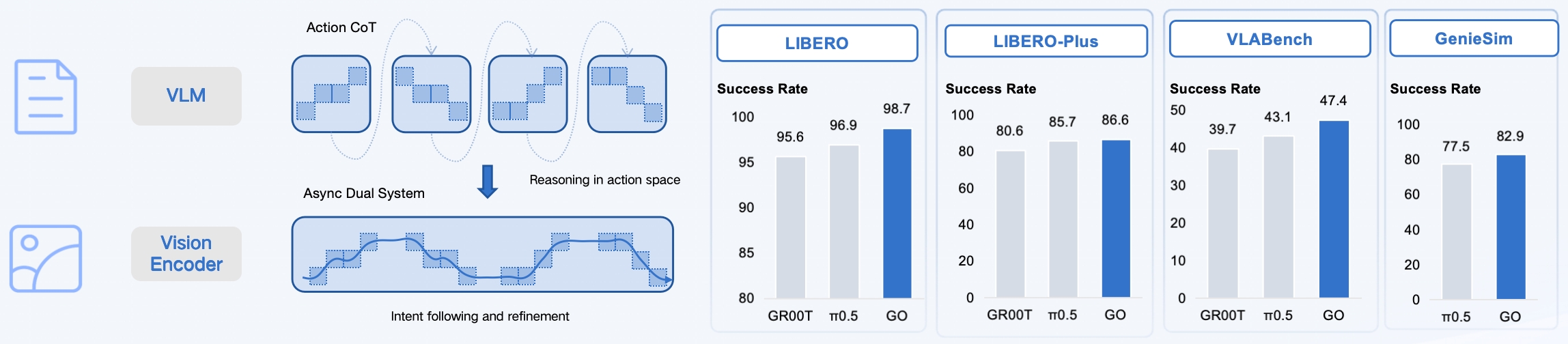
GO-2 represents a leap forward by integrating logical reasoning and action execution into a unified architecture, which AGIBOT claims bridges the "last mile" in robotic functionality. The model leverages tens of thousands of hours of interaction data to transition from a "black-box" approach to a more transparent system where reasoning and action are interconnected. This shift is crucial, as traditional models often suffer from a disconnect between high-level reasoning and the motor commands necessary for execution, leading to errors and instability during task performance.
To achieve this integration, AGIBOT has developed two key innovations: the action chain of thought and an asynchronous dual-system architecture. The action chain of thought allows GO-2 to generate executable action plans through deep spatial reasoning, effectively simulating the decision-making process before execution. Meanwhile, the asynchronous dual-system approach ensures that high-level reasoning translates into precise movements, with a semantic planning module providing structured action sequences and an action-following module refining these commands in real-time. This duality not only enhances execution stability but also allows the model to adapt to environmental disturbances, a significant advancement in robotic performance.
Furthermore, AGIBOT's commitment to continuous learning through the integration of GO-2 with its Genie Studio platform facilitates real-world deployment and ongoing improvement. The model's ability to collect data across fleets of robots and engage in cloud-based collaborative training enhances its adaptability and efficiency, reducing task startup times and improving operational rates significantly. This transformative approach positions GO-2 not merely as a static model but as a dynamic system capable of evolving and improving over time, which is essential for maintaining competitiveness in the rapidly advancing field of robotics.
In addition to the immediate capabilities of GO-2, AGIBOT is also exploring the potential for robots to develop long-term memory through its OpenClaw Memory System. This research aims to create a complete intelligent loop that encompasses perception, reasoning, action, and memory, further enhancing the sophistication of embodied agents. As AGIBOT continues to push the boundaries of what robots can achieve, the implications for industries reliant on automation and AI are profound, signaling a future where robots can learn from their experiences and adapt to new challenges autonomously.