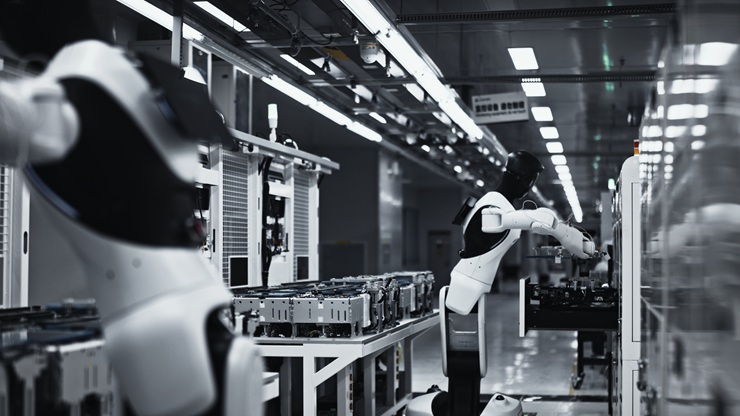
- The deployment of AGIBOT G2 at Longcheer Technology signifies a pivotal moment in the integration of embodied AI into consumer-electronics manufacturing.
- This initiative showcases the potential for embodied intelligence to enhance manufacturing flexibility and efficiency, addressing longstanding challenges in the industry.
- AGIBOT's approach not only demonstrates immediate operational success but also sets the stage for broader adoption across various sectors, including automotive and energy.
The successful deployment of AGIBOT G2 robots at Longcheer Technology is a landmark event that underscores the urgency of integrating advanced AI systems into manufacturing processes. As the consumer electronics sector grapples with increasing demands for flexibility and rapid production cycles, the introduction of embodied AI represents a transformative shift from traditional automation methods. This development is particularly significant as it marks the first large-scale implementation of such technology in a real-world production environment, moving beyond experimental phases to practical applications that promise measurable economic benefits.
AGIBOT's G2 robots have been seamlessly integrated into Longcheer’s tablet production lines, operating alongside human workers in a dynamic manufacturing setting. This integration is not merely a technical feat; it validates the effectiveness of embodied AI in precision manufacturing. Dr. Yao Maoqing, a key figure at AGIBOT, emphasizes that this deployment signals the readiness of embodied intelligence for widespread industrial use, highlighting its reliability and potential for delivering economic value. The collaboration with Longcheer has accelerated the transition from innovation to production, achieving operational stability and meeting performance targets within a remarkably short timeframe.
The deployment addresses critical challenges faced by consumer-electronics manufacturers, such as rigid production lines and lengthy reconfiguration cycles. By leveraging embodied intelligence, AGIBOT's solution allows for rapid adaptation to changing production requirements without the need for extensive hardware modifications. This flexibility is crucial in an industry where product lifecycles are shortening and the demand for small-batch production is increasing. The AGIBOT G2 robots are specifically designed to perform precision tasks at Multimedia Integrated Testing (MMIT) stations, showcasing their ability to navigate complex factory layouts and execute operations with millimetre-level accuracy.
The operational metrics achieved by the AGIBOT G2 robots are impressive, with throughput reaching up to 310 units per hour and a success rate exceeding 99 percent during continuous operation. These figures not only demonstrate the robots' efficiency but also their capability to support 24/7 operations with minimal human intervention. The rapid deployment and integration of these robots into production lines—completed in just 36 hours—further illustrate the potential for AGIBOT's technology to enhance manufacturing processes significantly. As AGIBOT plans to expand its deployment to 100 robots by Q3 2026, the implications for other sectors, including automotive and energy, are profound, suggesting a broader shift towards intelligent, software-driven manufacturing systems.
This milestone reflects a critical evolution in manufacturing paradigms, moving away from rigid, hardware-defined automation towards flexible, intelligent systems powered by embodied AI. The success of AGIBOT G2 at Longcheer Technology not only sets a precedent for future implementations but also highlights the growing importance of adaptability and efficiency in modern manufacturing environments. As industries continue to evolve, the integration of such advanced technologies will be essential for maintaining competitive advantage and meeting the demands of a rapidly changing market.